
LESSON 1
Our Residential Service
est time: 5 minutes

Course Instructor - Jake Silcock, Owner
Jake started his first pest removal company in his teens. Since then he has done every position in the industry from research, sales, application, and customer service. He has founded multiple companies in multiple states.
Along with his experience in the field, Jake studied entomology and pest management, along with a degree in fisheries, wildlife, ecology and range.
The Home Service
The home service is the most popular account sold by reps. It’s the bread and butter of residential pest control. The object of this service type is to remove any and all pests from inside the living space of the home, in the walls, attic, crawlspace, as well as off of and away from the exterior of the home.
Once pests are removed, the goal is to then keep them from making their way back into the home. This is achieved by physically sealing off any and all visible entry points. The home is then treated with product to further prevent the chance of pests finding their way onto or back into the home.
The inside treatment is a multistep process that includes inspection, exclusion/prevention, and treating. The tech will first inspect the home and ask a series of questions to identify needs that are specific to the customers home. During the inspection, any access points where pests can enter the home will be sealed off physically with either caulk, silicon, mesh, or foam. This practice will prevent (exclude) pests from freely reentering.
If a chemical treatment is needed, most of the time it will be, in most cases we will treat inside with a handcan applying a crack-crevice treatment along the edges of the floorboards, following them around the entire perimeter of each wall on the inside of the home. We may also bait areas, dust certain areas, inject a foam that will expand into hard to reach areas, or potentially use an aerosol. It all depends on what pests we are working with, and what the home’s needs are. In most cases, we will also lay down a series of monitoring boards (sticky traps) to help monitor pest activity, identify specific pests, and accelerate the clean out process inside.
The outside process also begins with an inspection. Any specific needs can then be cared for. For example, if entry points are found, they will be physically sealed off if possible. If rodent droppings are found we will look for anything that has been attracting them such as trash being left outside of dumpsters or trash cans. We will carefully make recommendations of steps for the customer to take that will help avoid future problems. We may then leave a pet-proof/child-proof system in place to remove the current rodents residing in the area, and prevent future ones from hanging around the home.
Another important service we provide to the exterior of the home is the removal of wasp nests and spider webs. Using a brush that extends three stories high, we sweep the eaves and corners of the home free of all webs and wasp nests, including mud dauber (a type of wasp) nests. The most common nests are paper wasp nests and mud/dirt dauber nests which are made of clay and leave a residue/stain on the home. After all of the wasp nests and spider webs are removed, the undersides of the eaves and covered portions of the wall are then treated to prevent future webs and nests.
Next to sealing off all entry points, the exterior treatment is the most important feature of our service that provides long term control and prevention of all things pest related. These include the weep holes located near the base of brick homes. They must be treated within and then screened off.
After sealing off entry points, the only way to efficiently achieve actual control at all levels is by using a power sprayer equipped with the right type of product, mixed at the right ratio.
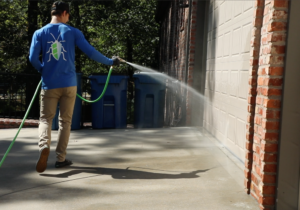
Using the power sprayer we are able to treat as high as the third story eaves as previously mentioned, as well as up each wall, and as far out as needed.
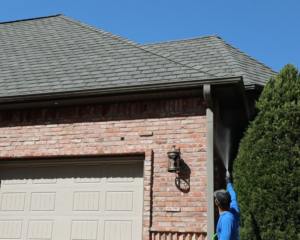
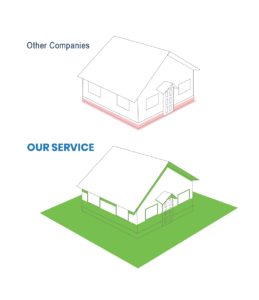
Our standard for a regular home treatment is to treat at least 7-10 feet out. By treating the eaves, up each wall, and 7-10 feet out it establishes an invisible barrier that will keep bugs away for at least 90 days.
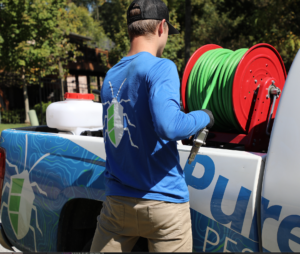
On the initial service we will treat both the inside and the outside. We also refer to their initial service (the first visit) as the “clean out service”, because we remove all active and breeding pests from the inside, and leave a residual treatment to help remove any larvae that may have been tucked away in inaccessible areas, or recently hatched from eggs that weren’t able to be reached.
After the initial service, all of the regular services (all subsequent visits) should only need the exterior barrier reapplied. We will, however, retreat the inside if it is needed for no additional charge. It is through proper inside/outside sealing and treatments that we are able to effectively keep homes pest free.
One of the most important steps of the process that is most often missed by other companies is the service specifically designed to break down the egg cycle. This is by far the most important part of the entire removal and prevention process. Eggs are similar to seeds. To help understand the importance of the egg cycle removal and struggles in doing so, let’s talk more about seeds: In almost any given patch of dirt, there are multiple generations of seeds on the surface of the soil or buried and varying depths. This is referred to as the seed bank. Plants have evolved to not have all of their seeds germinate and emerge at once in order to insure the success of that plant species. That way, if there is a drought or fire the plants will not all be wiped off the face of the earth. They typically emerge in stages, some being years apart. So if a homeowner is trying to remove annoying weeds from their yard, they first need to remove the plants dropping the seeds there. Even if the seed bearing plants are removed, the weeds will most likely spring back up due to the seeds in the soil. Until all of those seeds are removed, the problem will forever subsist. This is the same with bugs.
A great example is with ants. Let’s say that a colony invades the bathroom of a home and establishes a colony within the wall next to the shower. Each set of eggs that a queen lays will emerge in stages. Let’s say hypothetically that those stages are one week apart from each other, and that she has four weeks worth within that wall at the time of the first treatment. During the first treatment, all the active adults will be removed. But we still have eggs, larvae, and pupae within the wall. Eggs will hatch into larvae, and most larvae need adults to care for them. Not all, however. So some larvae may indeed mature in the pupal stage. Out of the four weeks worth of offspring in the wall at the time of the first treatment, two may already be in pupal form and will soon emerge from the wall as fully functioning adults. So there is the chance that they may emerge in two to four different waves, potentially being weeks apart. This means that the likelihood of reinfestation is guaranteed.
With the example of the ants in mind, with the proper treatment schedule and the correct products in place, the egg cycle can be effectively broken down and removed. This is the importance behind our egg cycle service that we perform roughly 30 days after the initial service. For most pests we are able to get enough lifespan out of the products used on the inside of the home to accomplish the removal of the egg cycle. However, for pests like ants, cockroaches, and fleas, we will for sure need to treat the inside again during the 30 day egg cycle removal visit. With any flea infestation, due to a much shorter incubation period, we will return just 14 days after the initial treatment.
Customers love that fact that after the initial service they no longer need to be home for any of the subsequent visits (unless we need to do the inside again due to ants, roaches, fleas, etc). It is extremely convenient, and only possible because of how effective our service is. This is actually a really big deal. We always notify the customer one week and also one day before their next treatment via an automated text and email that states we will be coming by. If they have any specific requests or needs, they can text or email back and our office will add specific, customized notes for the tech, or address the customer’s needs right away. This is also a huge convenience.